


The Normalization of Ethnic Cleansing: The Dangerous Precedent of Artsakh

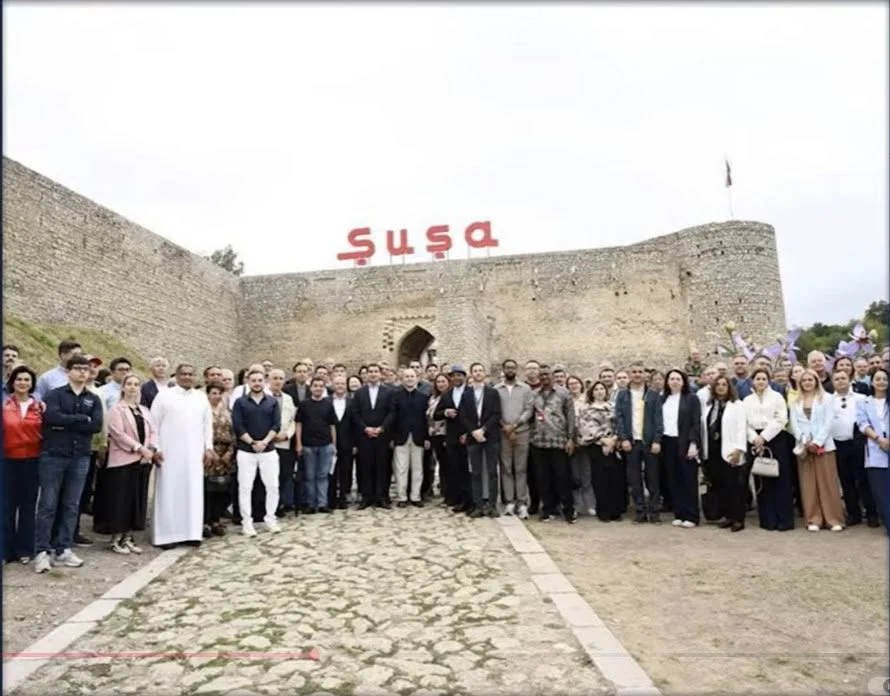
On September 11–12, 2026, the Azerbaijani authorities organized the largest visit to date by the foreign diplomatic corps to Artsakh (Nagorno-Karabakh). Some 150 representatives of 58 countries and nine international organizations took part. They visited Stepanakert, Shushi, the Martakert and Karvachar districts, including the Armenian monasteries of Gandzasar and Dadivank. According to Azerbaijani sources, this was already the twenty-second organized visit by members of the diplomatic corps to these territories since 2020.
What were they shown?
New roads and tunnels, apartment buildings, a university, factories, the “return” of Azerbaijanis, and a supposedly “reviving” Stepanakert and Shushi. Many of the diplomats praised the scale and speed of the construction. Yet in their public statements, the simplest question was never asked: Where are the Armenians of Artsakh?
They did not simply disappear. As a result of the 2020 war, subsequent Azerbaijani military pressure and displacement, the ten-month blockade of 2022–2023 and the starvation it inflicted, and the final assault of September 2023, more than 130,000 Armenians of Artsakh were displaced between 2020 and 2023. The overwhelming majority of those who had remained in Artsakh until September 2023 were forced to flee within a matter of days, leaving their homes—and a homeland belonging to all Armenians. By the end of that exodus, Artsakh had been almost completely emptied of its indigenous Armenian population.
So what exactly is meant by the “return of life”? Whose life has returned to Stepanakert when its Armenian inhabitants are living under forced displacement in the Republic of Armenia and elsewhere? Whose “resettlement” are foreign diplomats welcoming when the indigenous population of that land is denied the possibility of returning to its homes?
This grotesque diplomatic silence has a very concrete political consequence: the “result” of ethnic cleansing is gradually being legitimized and normalized.
Only three years ago, Armenians lived in Artsakh, as they had from time immemorial. They were forcibly driven out. Today Azerbaijanis are being settled in Armenian towns and villages, while diplomats from dozens of countries visit these places and praise their “reconstruction.” It is difficult to imagine a more favorable picture for the dictatorial regime in Baku: the crime has been relegated to the past, while the “new reality” created by that crime is already being presented to the world as “normal life.”
But the process did not end with the removal of the Armenians. The erasure of the Armenian presence in Artsakh is now proceeding at full speed.
The most striking examples are Gandzasar and Dadivank. There, the diplomats were presented
with Azerbaijan’s official state narrative that these Armenian monasteries constitute “Caucasian Albanian” heritage. In the case of Gandzasar, this is being done in a monastery whose walls bear Armenian inscriptions and whose history is inseparably connected with the Armenian Apostolic Church, the Armenian Principality of Khachen, and the liberation struggles of the Armenians of Artsakh in the eighteenth century, in 1917–1920, and in 1988–2023.
This is not ordinary historical falsification. It is the continuation of ethnic cleansing in the cultural sphere: first remove the Armenians from Artsakh, and then remove Armenian history from Artsakh.
It is here that Raphael Lemkin’s formulation of 1944 receives an almost chilling confirmation. Lemkin did not reduce genocide to the physical destruction of human beings. He described two successive phases: the destruction of the national pattern of the oppressed group, followed by the imposition of the national pattern of the oppressor: “Genocide has two phases: one, destruction of the national pattern of the oppressed group; the other, the imposition of the national pattern of the oppressor.” Moreover, he explicitly observed that the latter could be imposed on the territory alone, after the removal of the population and the colonization of the area by the oppressor’s own nationals.
This is precisely the process now unfolding in Artsakh: the expulsion of the Armenian population, followed by the obstruction of its return, the resettlement of the territory, the elimination of Armenian place-names, the erasure of Armenian historical memory, and the “Caucasian Albanianization” and appropriation of Armenian cultural heritage.
And the issue is no longer an Armenian one alone.
The international legitimization of the ethnic cleansing of Artsakh is a disaster not only for Armenians. It is a threat to the entire system of international security. If the outcome of ethnic cleansing can, within a few years, be transformed into an internationally acceptable political reality, then the forcible removal of a population is effectively turned into an “efficient” method of solving territorial and demographic problems.
One is inevitably reminded of the notorious statement attributed to Adolf Hitler on August 22, 1939: “Who, after all, speaks today of the annihilation of the Armenians?” Days later, the Second World War began; in the years that followed came the systematic extermination of millions of people.
The Artsakh precedent may therefore teach the world an extraordinarily dangerous lesson: if you want to rid yourself of an unwanted population, finish the job. Remove the entire population quickly, create an irreversible fact on the ground, ignore the feeble attempts at international condemnation, then build roads and new residential districts, organize visits by foreign diplomats, and wait. Before long, the world will cease talking about the return of the forcibly displaced and will instead begin discussing the economic development of the “new reality” you have created.
This is the most dangerous aspect of the Artsakh precedent. Ethnic cleansing that is successfully completed and left unpunished becomes a model for imitation.
When the international community accommodates itself to the outcome of a crime, the deterrent force of international law collapses. Today, in practice, the most important function of the 1948 UN Convention on the Prevention and Punishment of the Crime of Genocide—prevention—has been gravely undermined, even though 154 states are currently parties to the Convention.
Was it merely a coincidence that almost immediately after the depopulation of Artsakh, the world was confronted with the catastrophe in Gaza—the mass killing and displacement of Palestinians and the large-scale destruction of the conditions necessary for civilian life? Today, different manifestations of the same dangerous processes are visible in the West Bank as well, while the population of southern Lebanon has suffered the grave consequences of expanding military operations. Genocidal massacres are also taking place in Sudan.
Of course, Artsakh did not “cause” Gaza. But Artsakh and Gaza expose the same grave disease of the international system: its inability to stop mass atrocities in time, followed by its readiness to accommodate itself to realities created by force.
Far more is therefore at stake in Artsakh today than the fate of Artsakh and the Republic of Armenia alone.
The world is deciding what lesson it will draw from what happened there. And this latest visit by foreign diplomats to Artsakh unfortunately suggests that, for the moment, an openly fascistic Turkish-Azerbaijani model—one that treats ethnic cleansing and genocide as acceptable instruments for achieving political objectives—is prevailing over the principles that the international order supposedly exists to defend.
The consequences will not be long in coming. They will become increasingly visible in many other parts of the world.
As for us Armenians, we must draw our own conclusions and address the fundamental questions of our security by every possible means—and, when necessary, by means that today may seem impossible.

 LIVE Now



 Most Popular
 Artur Hovhannisyan and the Ambassador of Bulgaria to Armenia discussed a number of programs of mutual interest to Armenia and Bulgaria


